
Inspiring Audiences and Artists for Fifty-Six Years.
Buy Tickets Online > or call (831) 659-3115
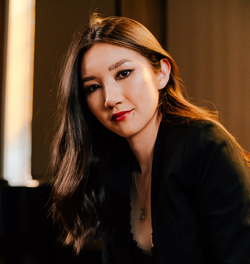 (photo: Kevin Ng) Composer Daixuan Ai gets by with a little help from her friends. Seriously. Her cat Dottie and her human friends give her strength to get through the bad days. Because for her, being an early-career composer means pinballing between the ecstasy of doing what she loves all day every day, and the despair of having chosen a career with no clear path to success.
Her path began as a concert pianist, with studies at the Wuhan Conservatory in China. She's currently a doctoral candidate at the Jacobs School of Music at Indiana University. While still a student, she's already a working professional composer, as well, with works performed at the Aspen Music Festival, by the Albany Symphony, by Hub New Music, and many others.
Her compositions combine tradition with modernism, often connecting Eastern and Western cultures. She's also dedicated to teaching, both locally (through IU's Composition Academy) and globally, through social media, where she fields inquiries from aspiring composers from around the planet.
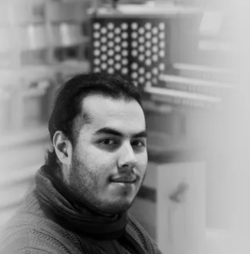
Look for composer Louis Dhoore at their composition desk at 12:26am. In the equilibrium of that quiet moment, they find the ultimate combination of relaxation and focus to unleash creativity.
At other moments, seek Dhoore by DMing Dungeons and Dragons. Dhoore thrives in constructing rich worlds for players to explore. That collaborative storytelling in a world of language perfectly mirrors their musical creativity; Dhoore dives into symbolic realms of feeling through collaborative encounters with fellow musicians.
They're currently pursuing a master's degree in composition at DePaul University in Chicago, and writing an orchestral piece called Juggler. Dhoore is an accomplished bass-baritone, and plays violin, viola, and viola da gamba.
And by the way, if you're finding Dhoore at 12:26am, you've said their name correctly.
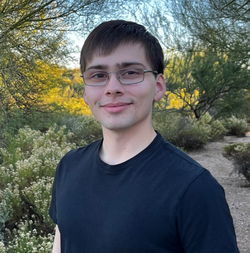
Composer Nicholas Edwards recognizes the infinite soul of his collaborators, and finds that both inspiring and terrifying. "How can I possibly do justice to their friendship, musicianship, and humanity in entrusting me to write for them? All I can do is my best, but I occasionally descend into a loop of infinite editing...good thing deadlines exist!"
Edwards is thrilled about this musical summer. He'll follow the exciting rigors of ECI with a week of hiking through the remote wilderness of Alaska's Denali National Park and writing a work inspired by the experience, music set to be played immediately both in Fairbanks and in the park.
Combining ECI and the Fairbanks Summer Arts Festival's "Composing in the Wilderness" program suits Edwards perfectly: he holds degrees from Vanderbilt University in Music Composition, and in Ecology, Evolution, and Organismal Biology. He's a published scientist and a composer.
 In five years, composer Rain Hou sees herself in a cozy apartment in New York City's Soho, walking a Bernese Mountain Dog, and living a life in musical creation. At age 20, she's an accomplished pianist, currently learning to play her favorite piece of all time, Alexander Scriabin's Sonata No. 4. "I usually try to keep my cool when I listen to emotional music, but this piece makes me tear up every time!"
Rain Hou just finished her freshmen year in New York City, majoring in creative writing at Columbia, and composition at the Juilliard School.
While she's soaking up the intense learning of her second summer at ECI, her string quartet "Flickered" will be performed at the Green Mountain Chamber Music Festival in Vermont.
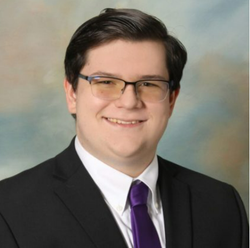 What happens when your time machine goes missing? What does it take to invent and refine a new language full of mouthly sounds? What's happening to the butterflies? How does one explore and express overwhelming realms of love amongst the matrix-wept mass that is this universe? These are the kinds of questions that animate the mind and work of 20 year-old saxophonist and composer Alexander Howard.
He's currently a student at the Manhattan School of Music in New York City, pursuing his dual passions of composition and saxophone performance. As an obsessed lover of music himself, Howard finds folk traditions from disparate cultures deeply compelling. His own compositions ring with melody, and focus on expressions of the ecstatic highs and cataclysmic lows of the human condition.
Howard is working on a cycle of songs based on mystical poems by Meister Eckhart, William Blake, and Hafez. And be sure to ask about his synesthetic responses – those inform his music, as well.
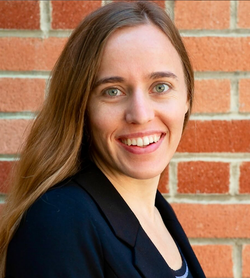 Composer Celina Anna Kintscher's life spans three continents. She was born in Germany, where her father lives. She went to high school in South Africa, where her mother lives. Today, Kintscher's heart lives in California.
Kintscher is inspired by silence. By the natural world. By collaborators who create with intent. And by being challenged. She feels a dual responsibility to the integrity of past works and the innovation of new music.
Her compositions merge African rhythms with Western harmony.
She's currently a student at UCLA. Her summer projects include ECI, and having the Arturo Toscanini Orchestra of Parma, Italy record her work "The End of the Beginning."
Kintscher says "music is my outlet. When I feel happy, I compose. When I feel sad, humorous, or lonely, I compose. I write music during the day and at night. I write music at home, on the beach, on mountain peaks, in buses, and airplanes. This is what I love most."
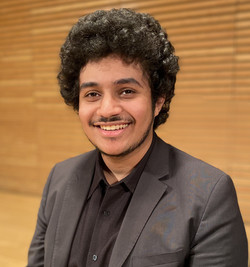 For composer Naveed Perkins, music and words blend and dance together into expressions of his deepest feelings. His intention as a creator is to be true to his musical and emotional intuitions.
He's currently an undergraduate at UCLA, just north of his origins in San Diego, always within reach of his inspiration in nature. When he's not composing, you might find him refreshing and fueling his creative process in Julian, California, at the crest of the mountains, looking down on the desert to one side, pine and cedar forests on the other.
Perkins is a pianist with 20 years experience, and is also conversant with all members of the string family.
The Iranshahr Orchestra and Hila Plitmann will soon premiere his song cycle for Soprano, Harp, and Strings. He's currently working on a new set of songs in English and Armenian, to be premiered in 2025.
 Composer Justin Schwartz has academic degrees in both Composition and Psychology, and for Schwartz, the two blend in endless spirals of inspiration and fascination. In observing his own neurodivergence, Schwartz finds pathways to creativity: his autism finds comfort in patterns, while his ADHD craves novelty. This fizzing tension fuels the emotional impact he seeks in music. If you're so inclined, you're welcome to analyze Schwartz's music, but first, open your heart.
Schwartz's musical palate is informed by his love of wide-ranging sounds, from Ligeti to Led Zeppelin to klezmer.
In addition to his work-in-progress for ECI, he's currently writing a piece for Grade 4 band, for bands at high school or college level. Schwartz finds joy in the challenge of creating beauty within those limitations.
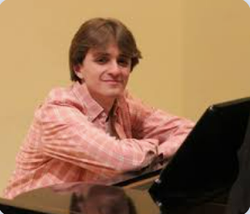 "Come to the woods, for here is rest. Between every two pine trees is a door leading to a new way of life. Of all the upness accessible to mortals, there is no upness comparable to the mountains." So said American naturalist John Muir, and so believes American composer J.T. Wolfe. He thrives in the uncertain spaces of liminality, the invitations to growth and reinvention that are all around us, if we have ears to hear.
Wolfe was born and raised in St. Joseph, Missouri. He's now a fourth-year student of music composition at the University of Missouri-Columbia, and is currently working on his first orchestral composition, on a commission from the St. Louis Symphony.
He's already deep in preparations for a solo piano recital in the spring of 2025, which will include his own compositions, works by fellow students, and his carefully curated favorites among recent composers.
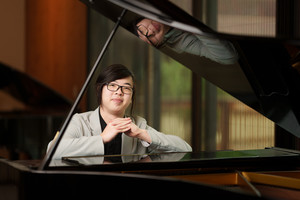 (photo: Kevin Hsu) Jonathan Wu is intent on the constant refinement of his technique and craft as a pianist, tennis player, and composer. He's currently pursuing undergraduate studies in both Piano and Composition at UCLA.
Born and raised in Shanghai, Wu now divides his time between Los Angeles and Singapore. He speaks Mandarin, English, Shanghainese, and chamber music, and is rapidly learning the challenging language of orchestral music.
His interest in movies, paintings, and especially books will always inform his work, but don't assume each of his compositions has a specific inspiration: his music is his music.
Jonathan is both bemused and proud to be the only 3-time composition fellow at ECI.
One of his greatest joys in life springs from collaborations with musical friends. People who see through the surface of his multiple linguistic and national identities, into his core. Those connections, beyond appearance and identity, fuel Jonathan's greatest joys in life.